Launch offer — valid today only

📄 Digital book in PDF · read it on your phone or print it

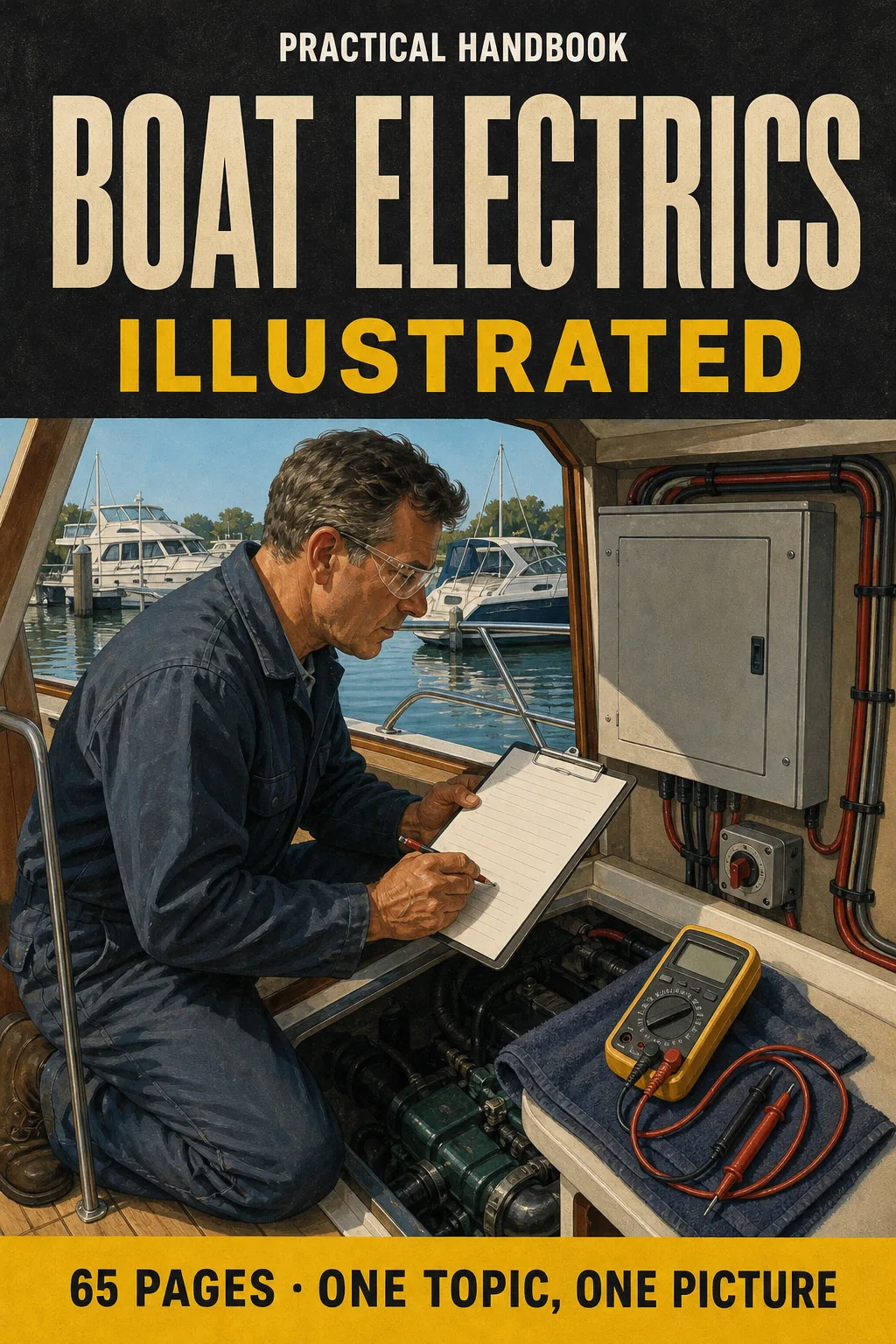
12 V and 24 V Boat Electrics, in Drawings One Circuit on Every Page

Battery banks, cable sizing, voltage drop, fuses, the battery isolator, charging, shore power, fault-finding and what a safety examination looks at. Every topic has its own page: first the drawing, then the numbers you need to remember. 65 illustrated pages.

SEE HOW IT'S DRAWN

🔒 Secure checkout · PDF by email · 30-day guarantee

Every topic, its own pageEvery circuit drawn and labelled, with the explanation beside it
65 illustrated pages8 parts, from your boat's system on one page to the most common mistakes
Up-to-date sourcesBoat Safety Scheme Essential Guide, BS EN ISO 10133 and BS EN ISO 13297
PDF by emailFormat

Look Inside the Book

Every page has one large drawing and a box with the numbers and steps you need to know:

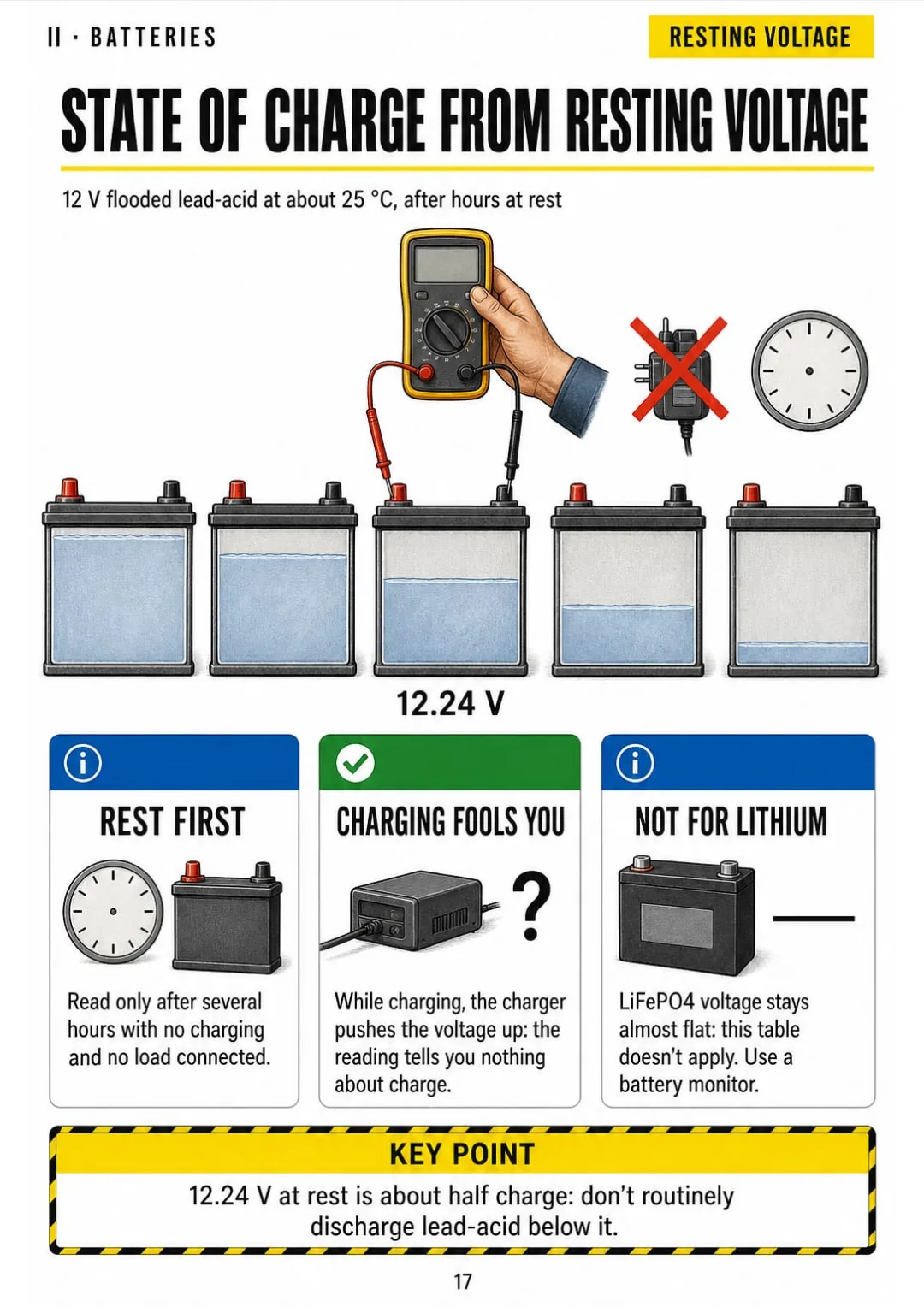
12.65 V full · 12.45 V 75% · 12.24 V 50% · 12.06 V 25% · 11.89 V empty (at rest).
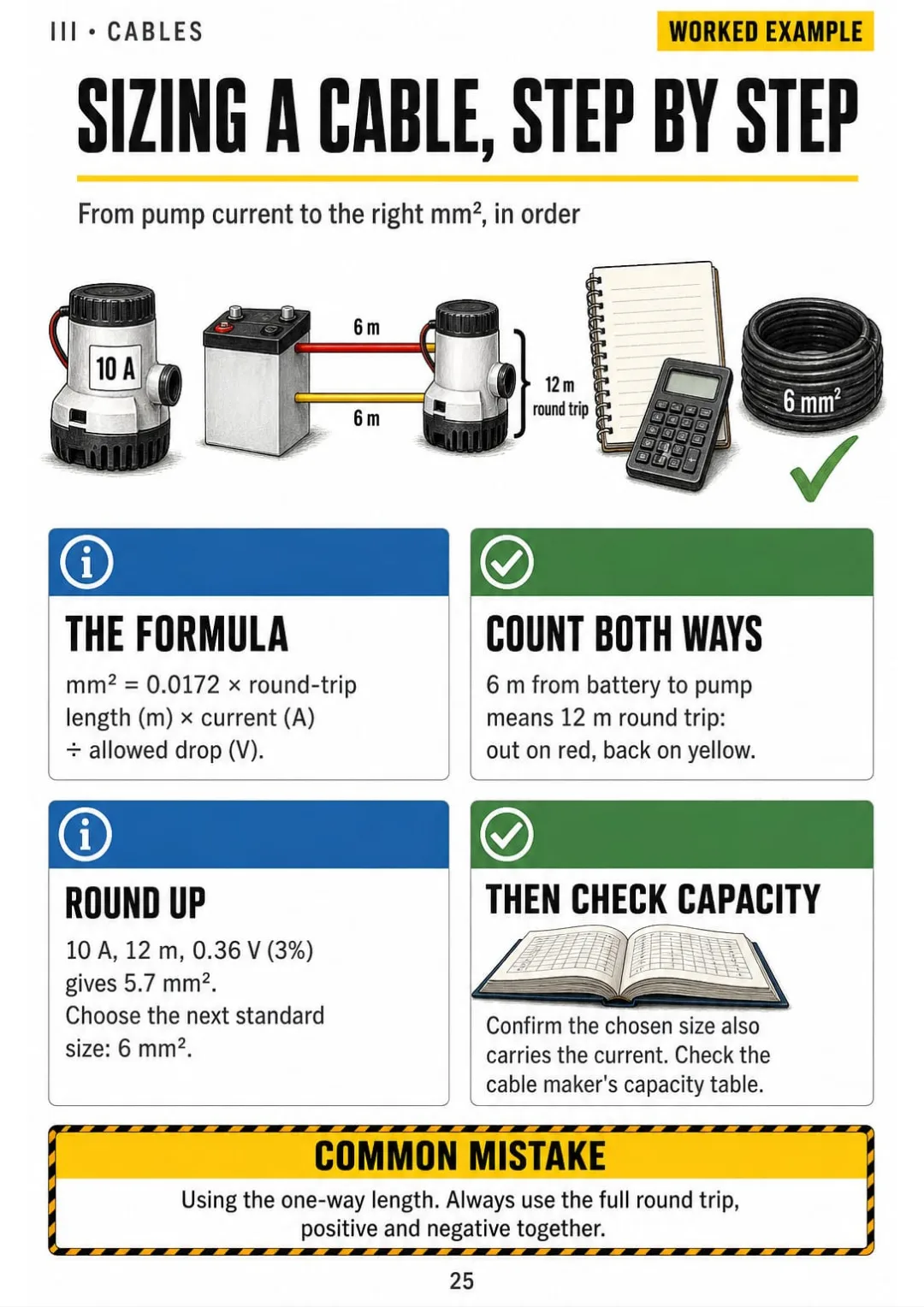
10 A over 12 m round trip at 0.36 V (3%) drop: 5.7 mm², so fit 6 mm².
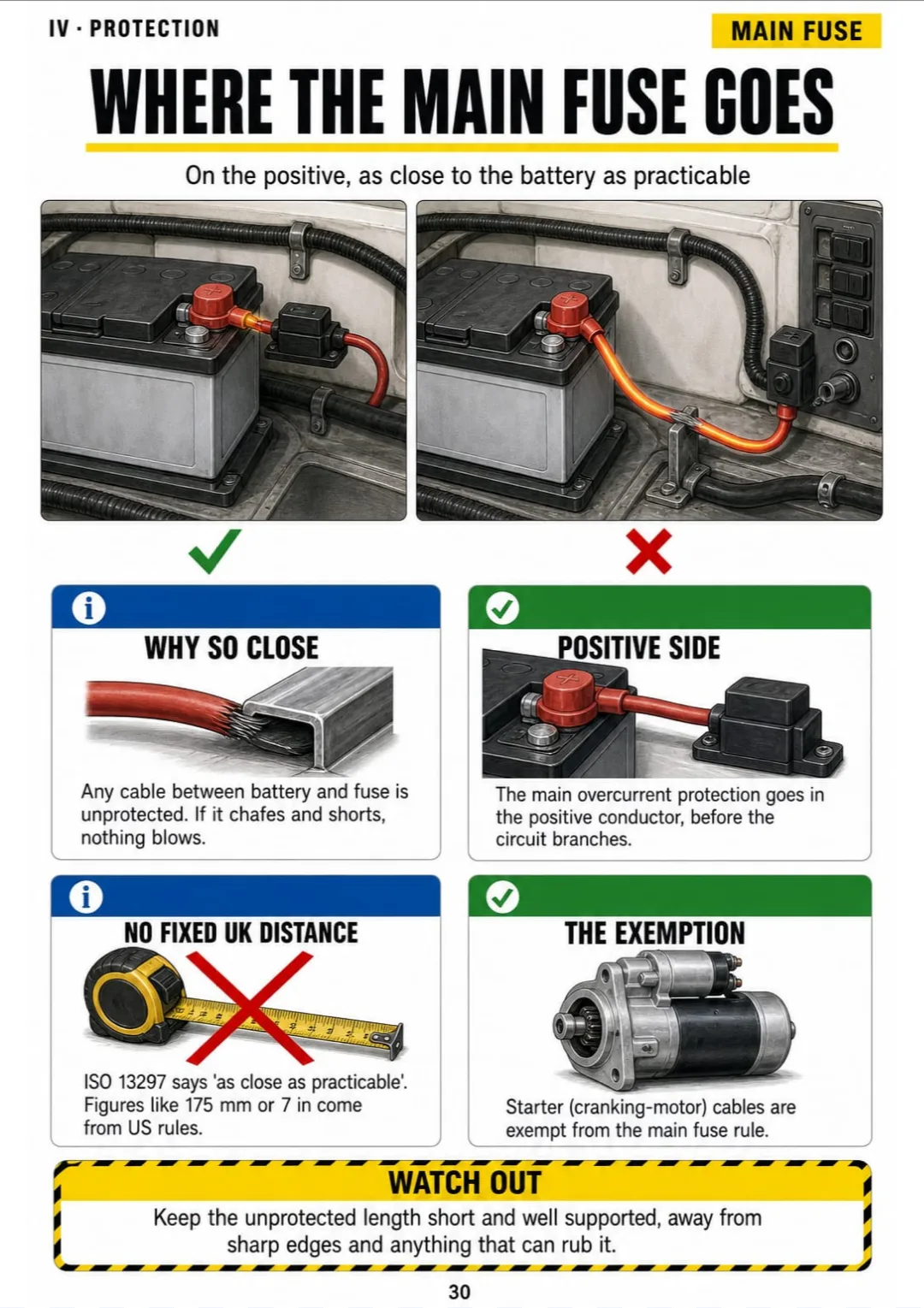
Main fuse: positive conductor, as close to the battery as practicable – no fixed UK distance.
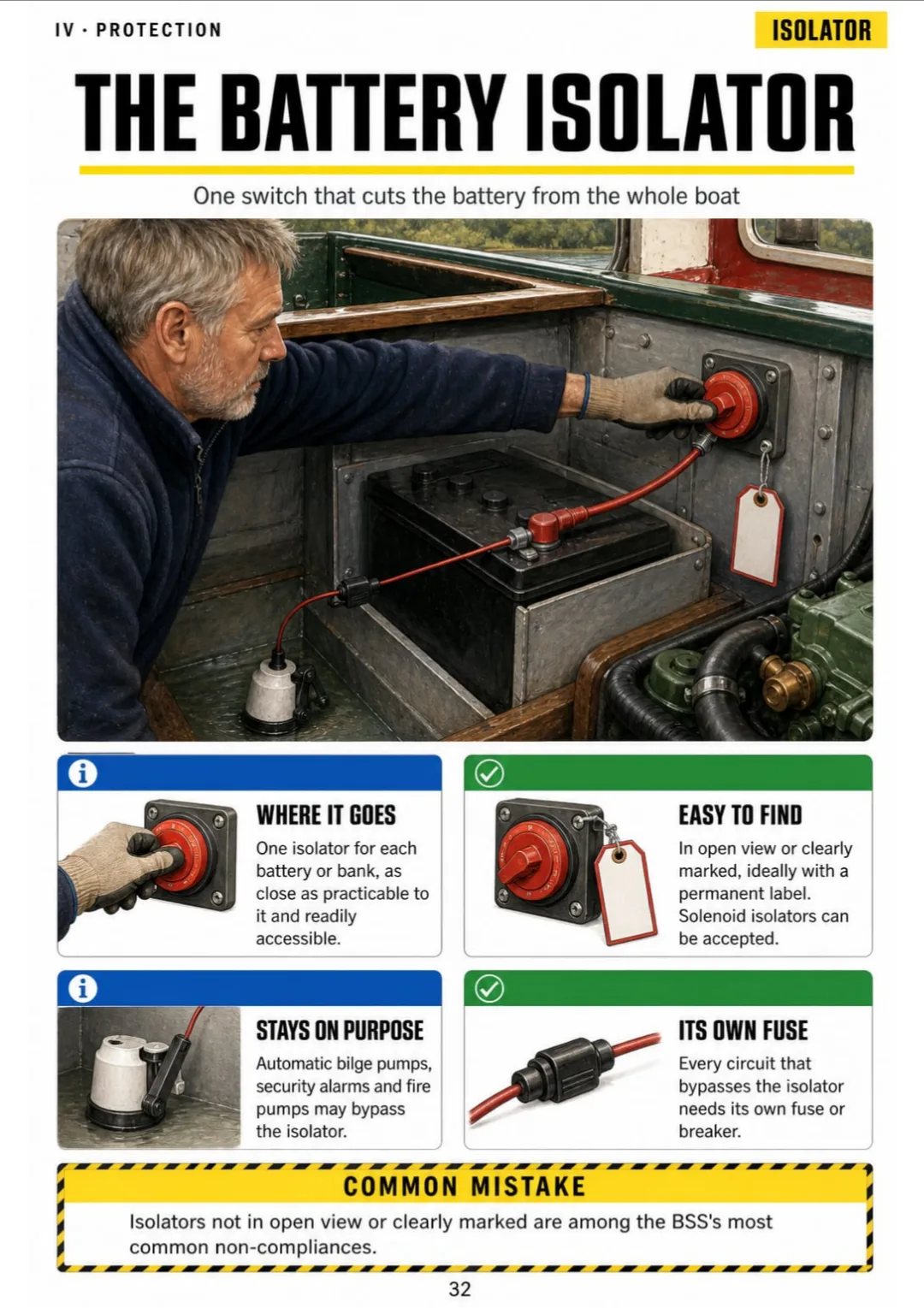
Isolator: near each bank, easy to reach, clearly marked – bypass circuits fused separately.
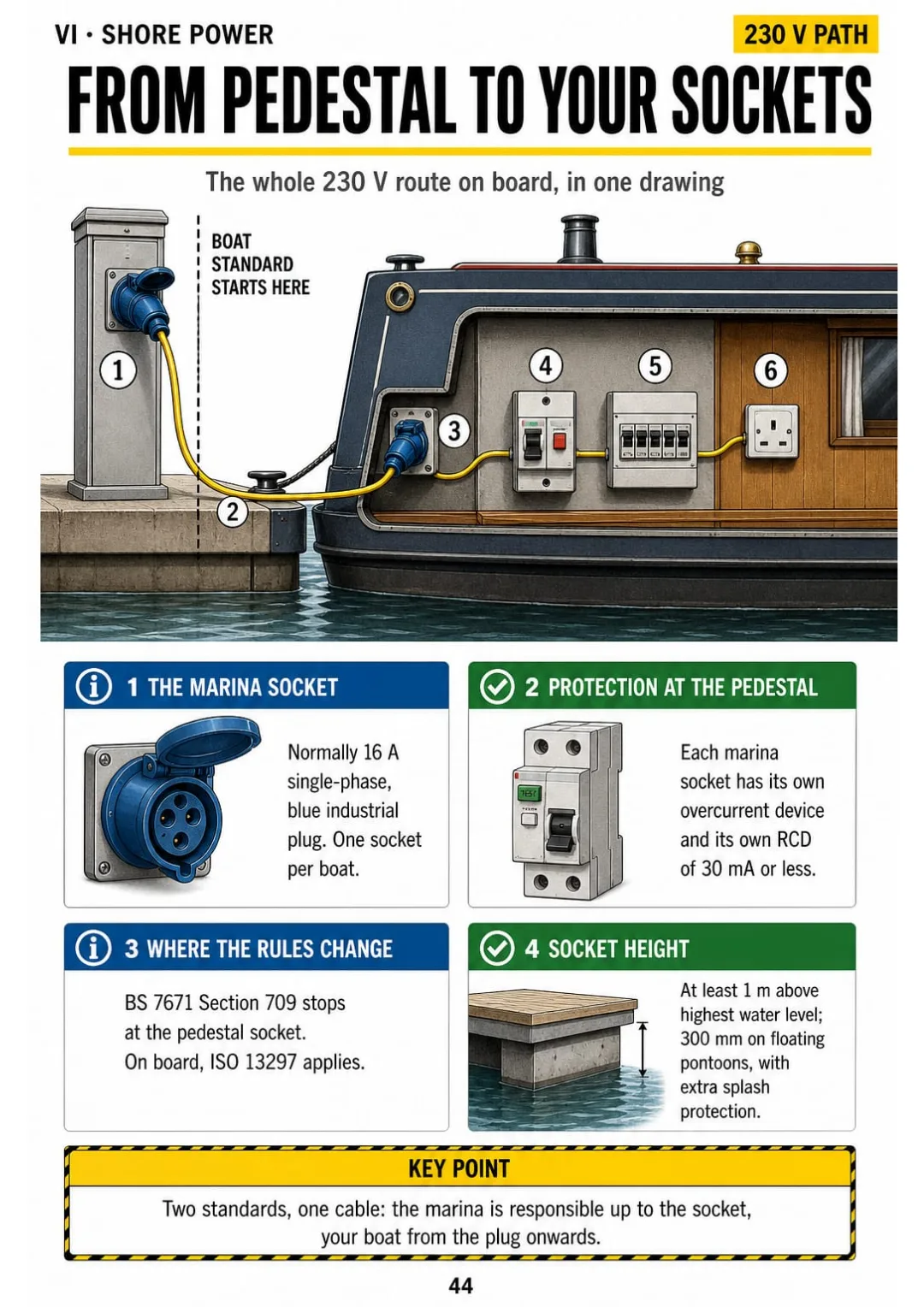
Pedestal, lead, inlet, double-pole main switch and RCD, consumer unit, sockets: the full 230 V path.
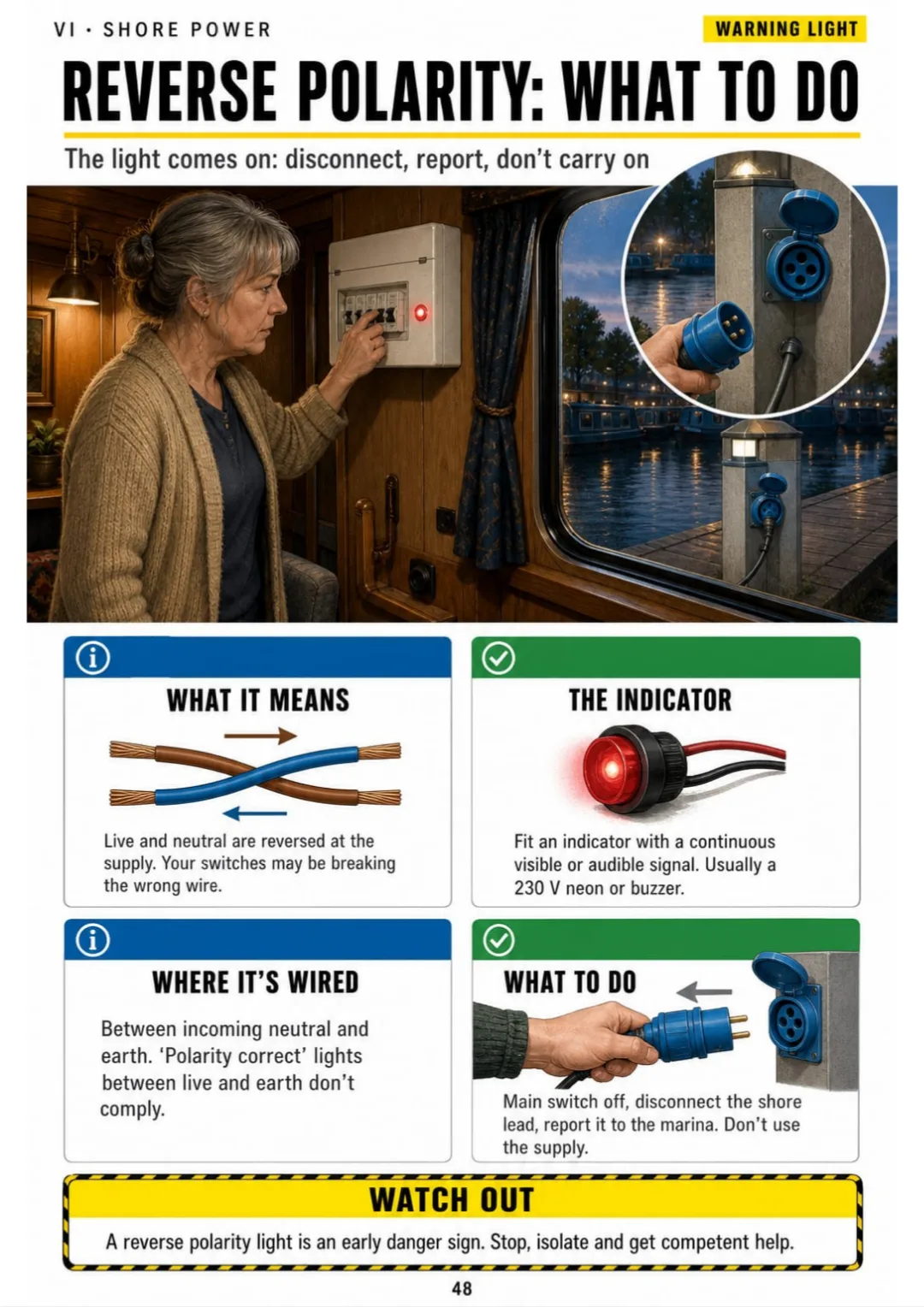
Polarity warning on: main switch off, unplug the shore lead and report it to the marina.
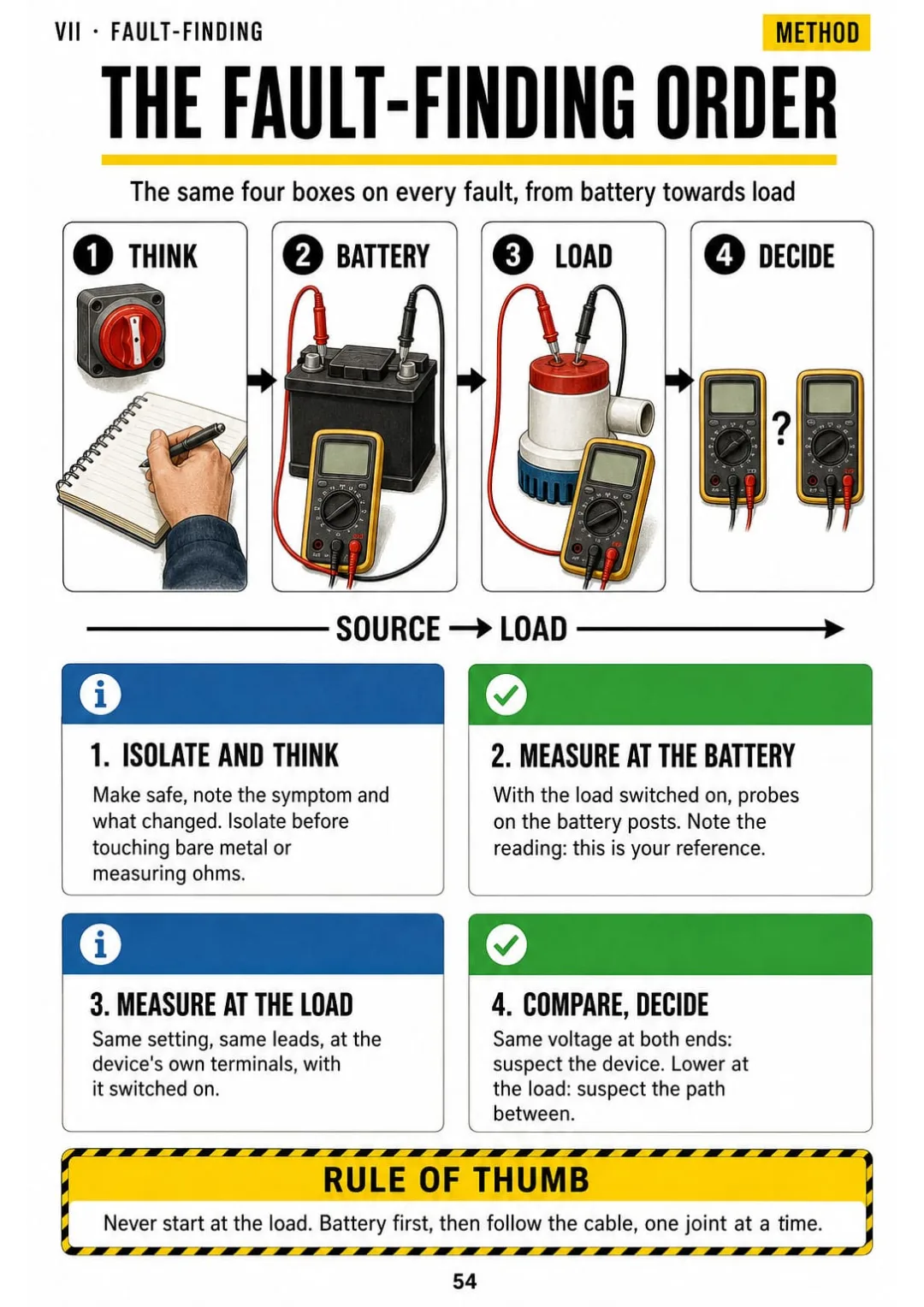
Isolate and think, battery, load, compare: the same four boxes on every fault
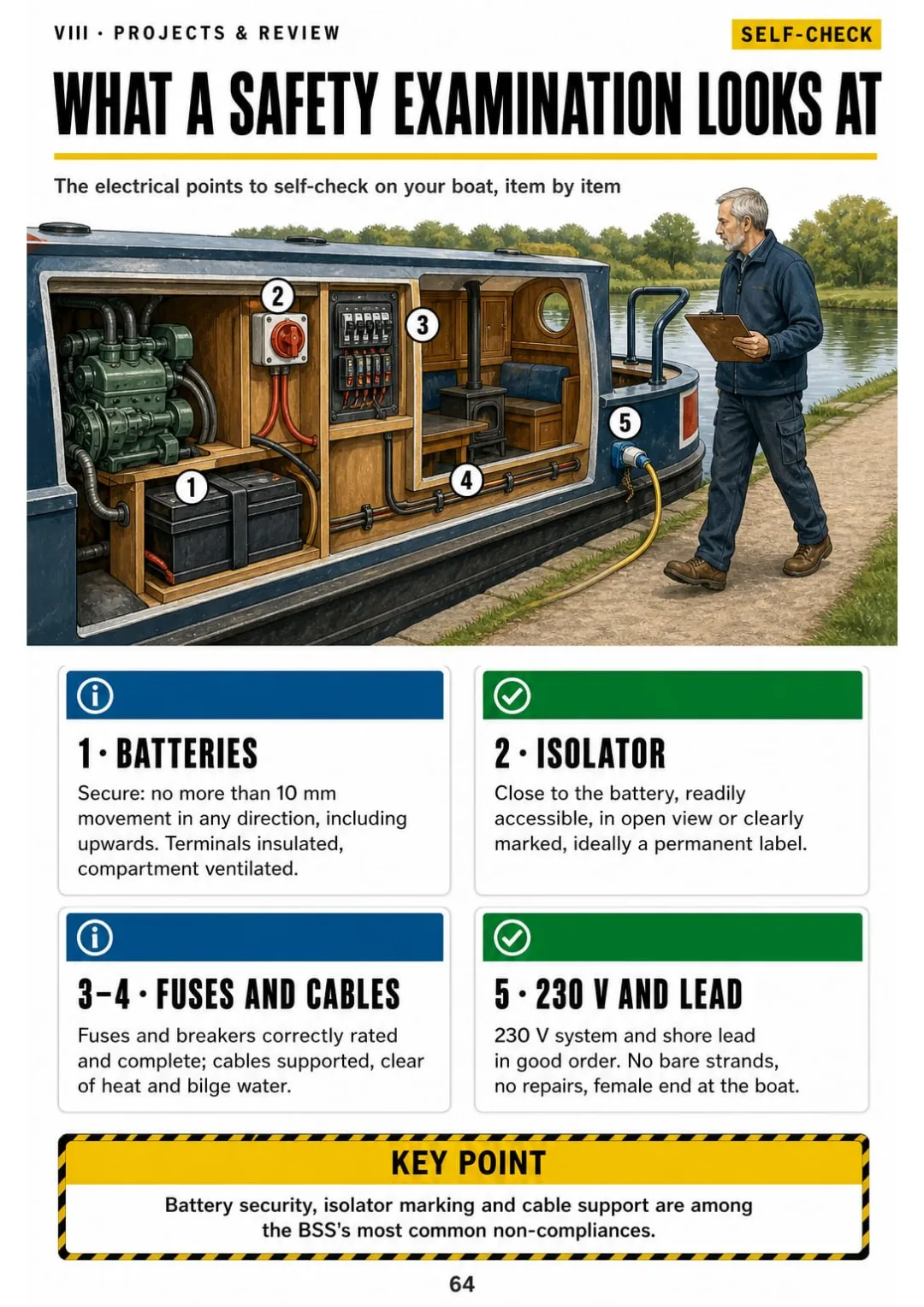
Batteries within 10 mm, terminals covered, isolator marked, fuses rated, cables supported, lead sound.

Swipe to see more →

These are real pages from the book. The table of contents is the full one: 8 parts and 61 topics.

The Problem Isn't You. It's How It Was Explained to You.

You're kneeling by the bilge with a new 10 A pump in one hand and a fuse holder in the other, and you can't decide: 10 A, 15 A or 20 A?

The manual spends three paragraphs on protective devices and conductor ratings. The forum gives you ten answers. None of them shows you what the fuse is actually there to protect.

Main fuse: positive conductor, as close to the battery as practicable – no fixed UK distance.

In the book it's one page: the battery, the fuse close to it, the cable run, the pump, all labelled. Above the pump's draw, below the cable's capacity: 10 A pump, 15 A fuse.

Where the main fuse goes, the battery isolator, voltage drop, bilge pump wiring and the fault-finding order work the same way: each one has its own page.

You fit the right fuse, you know why it's that one, and if the engineer asks, you have the answer without going back to the manual.

COMPARE FOR YOURSELF

The Same Topic, Two Ways to Learn It

THIS
  • The manual: line after line
  • Cable sizing explained only in words
  • You get to the job still unsure
The selection of conductor cross-sectional area for DC circuits shall take into account both the current-carrying capacity of the conductor under the installation conditions, and the permissible voltage drop over the total conductor length, which comprises the positive and negative paths combined. The voltage drop shall be determined from the conductor resistance per metre, the design current and the circuit length, and compared with the maximum percentage specified for the type of load, the next larger standard size being selected where the calculated value is exceeded.
FOR THIS
  • Cable sizing in one drawing
  • The amps, metres and mm² in a box
  • You see it and you get it
10 A over 12 m round trip at 0.36 V (3%) drop: 5.7 mm², so fit 6 mm².
CONTENTS

Take a Look at the 8 Parts and 61 Topics

How the system fits together, batteries and banks, cables and connections, fuses and isolators, charging, shore power and 230 V AC, fault-finding with a multimeter, and projects and checklists: 65 pages, all illustrated.

IHow a Boat's Electrics Fit Together · pp. 5-11
  1. Your boat's system on one page
  2. Volts, amps, ohms and watts in boat terms
  3. 12 V or 24 V: what changes
  4. DC and AC on the same boat
  5. Start bank and domestic bank
  6. Positive and negative: the full circuit
  7. Safe working order: isolate before you touch
IIBatteries and Battery Banks · pp. 12-20
  1. Inside a lead-acid battery
  2. Lithium (LiFePO4) on a boat
  3. Amp-hours and usable capacity
  4. Your daily power budget
  5. Series and parallel wiring
  6. Reading state of charge from resting voltage
  7. Battery monitors and shunts
  8. Mounting, venting and securing batteries
  9. Why batteries die early
IIICables, Sizing and Connections · pp. 21-28
  1. Marine cable: tinned and multi-strand
  2. DC cable colours
  3. Current-carrying capacity
  4. Voltage drop: why the pump runs slowly
  5. Sizing a cable: the worked example
  6. Crimping terminals properly
  7. Busbars and terminal studs
  8. Routing and supporting cables
IVProtection: Fuses, Breakers and Isolators · pp. 29-35
  1. What a fuse protects
  2. Where the main fuse goes
  3. Types of fuse and breaker
  4. The battery isolator
  5. The distribution panel
  6. Bilge pump wiring
  7. Switching on the positive, never on the negative
VCharging: Alternator, Solar and Chargers · pp. 36-43
  1. The charging cycle
  2. The alternator and warning light
  3. Charging two banks from one alternator
  4. DC-to-DC chargers
  5. Solar panels and controllers
  6. Shore-powered battery chargers
  7. Inverters
  8. Charging on a mooring without shore power
VIShore Power and 230 V AC · pp. 44-51
  1. From the marina pedestal to your sockets
  2. The shore lead and plugs
  3. AC cable colours
  4. RCDs and double-pole breakers
  5. Reverse polarity
  6. Galvanic corrosion and the shore earth
  7. Anodes and bonding
  8. When AC work needs a qualified electrician
VIIFault-Finding with a Multimeter · pp. 52-59
  1. Your multimeter, setting by setting
  2. The clamp meter
  3. The fault-finding order
  4. Voltage drop test under load
  5. Finding a hidden drain
  6. Engine just clicks
  7. Domestic bank flat every morning
  8. Bilge pump or light not working
VIIIProjects, Review and Checklists · pp. 60-65
  1. Project: replacing the domestic bank
  2. Project: adding a solar panel
  3. Drawing your own wiring diagram
  4. Winter lay-up and spring recommissioning
  5. What a safety examination looks at
  6. Most common mistakes

One Page, One Topic, All Clear

Think of it this way:

It's a Saturday in the boatyard, the new domestic bank is in, and you need to run a cable to the pump: twelve metres there and back. Which size?

You open the cable-sizing page and the run is drawn in front of you: battery, fuse, cable, pump, with the worked example beside it. 10 A over 12 m at a 3% drop: 5.7 mm², so you fit 6 mm².

Pedestal, lead, inlet, double-pole main switch and RCD, consumer unit, sockets: the full 230 V path.

The same goes for resting voltage, the battery isolator, bilge pump wiring, the path from pedestal to sockets and the fault-finding order: each one on its own page.

Boat Electrics Illustrated is 8 parts and 61 topics, all drawn, and at the end the step-by-step projects, the most common mistakes and the lay-up and recommissioning checklist.

What you see drawn, you don't have to memorize.

What's Inside Boat Electrics Illustrated:

Ipp. 5-11

How a Boat's Electrics Fit Together

Your whole system on one page, volts, amps, ohms and watts in boat terms, 12 V or 24 V, DC and AC together, start and domestic banks, the full circuit and the safe working order.

IIpp. 12-20

Batteries and Battery Banks

Lead-acid and LiFePO4, amp-hours and usable capacity, your daily power budget, series and parallel, state of charge from resting voltage, monitors and shunts, mounting and venting, and why batteries die early.

IIIpp. 21-28

Cables, Sizing and Connections

Tinned multi-strand cable, DC colours, current-carrying capacity, voltage drop, the cable-sizing worked example, crimping, busbars and routing.

IVpp. 29-35

Protection: Fuses, Breakers and Isolators

What a fuse protects, where the main fuse goes, fuse and breaker types, the battery isolator, the distribution panel, bilge pump wiring and switching on the positive.

Vpp. 36-43

Charging: Alternator, Solar and Chargers

The charging cycle, the alternator and warning light, charging two banks, DC-to-DC chargers, solar and controllers, shore chargers, inverters and charging on a mooring.

VIpp. 44-51

Shore Power and 230 V AC

From the marina pedestal to your sockets, the shore lead, AC colours, RCDs and double-pole breakers, reverse polarity, galvanic corrosion, anodes and bonding, and when AC work needs a qualified electrician.

VIIpp. 52-59

Fault-Finding with a Multimeter

Your multimeter setting by setting, the clamp meter, the fault-finding order, voltage drop under load, hidden drains, an engine that just clicks, a flat domestic bank and a dead pump or light.

VIIIpp. 60-65

Projects, Review and Checklists

Replacing the domestic bank, adding a solar panel, drawing your own wiring diagram, lay-up and recommissioning, what a safety examination looks at and the most common mistakes.

At the end of the book: Worked examples with numbers and units, fault-finding flowcharts, step-by-step projects and a lay-up checklist.
Plus: 2 Free Books

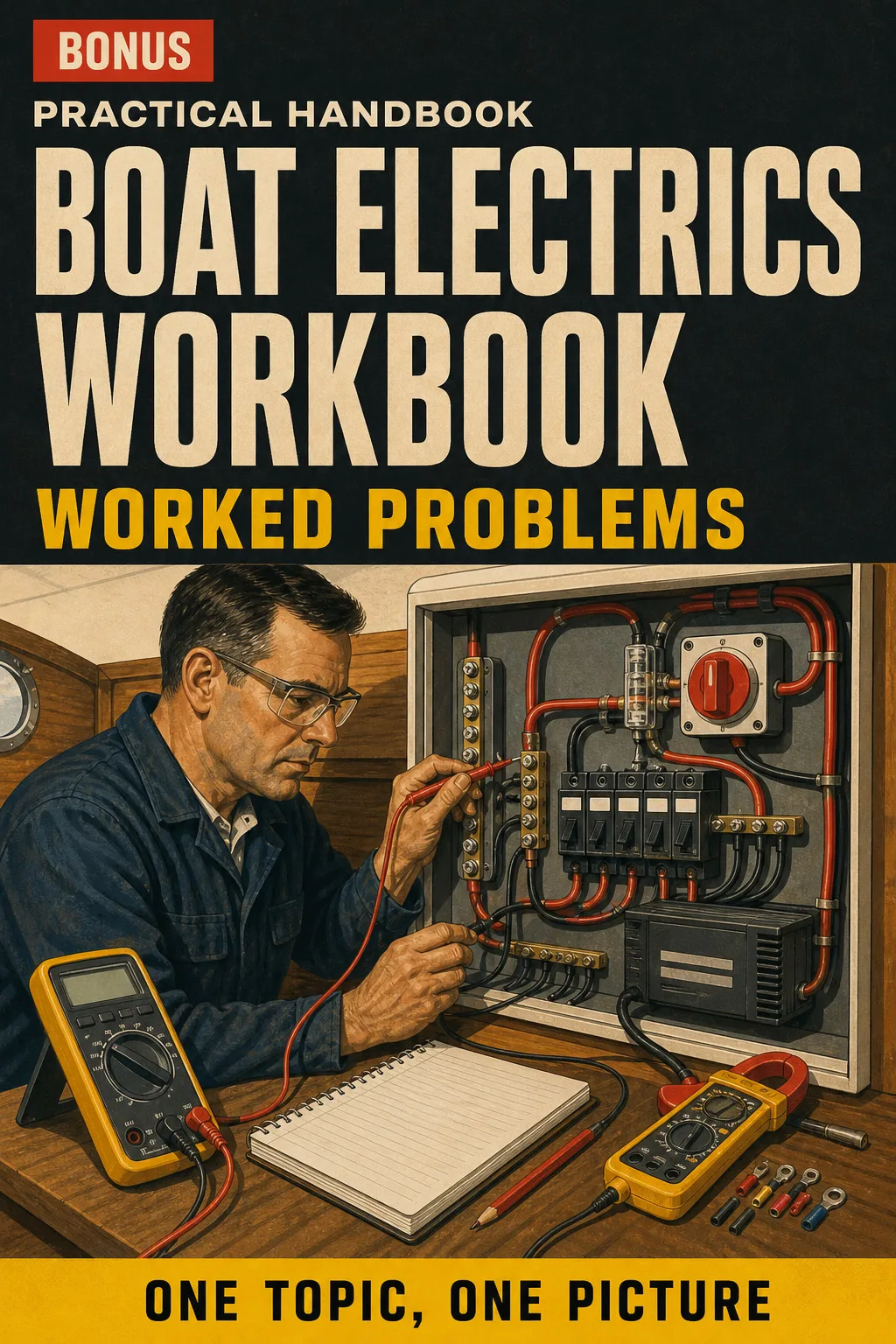
Boat Electrics Workbook: Worked Problems

BONUS 1: «Boat Electrics Workbook: Worked Problems»

Value on its own: US$ 17.90

Practise Ohm's law, cable sizing, voltage drop and fault-finding on real boat circuits, with every answer worked through step by step.

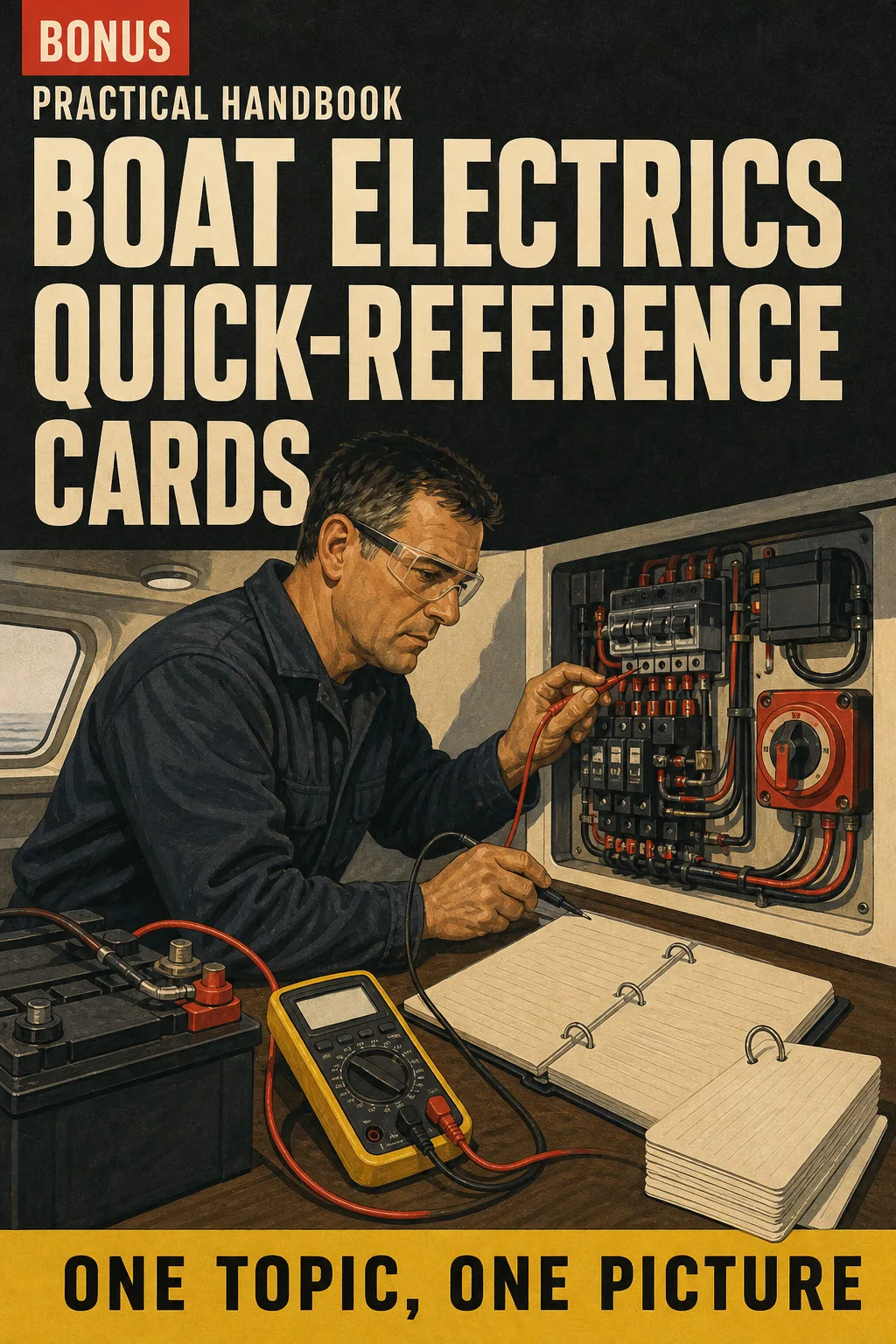
Boat Electrics Quick-Reference Cards

BONUS 2: «Boat Electrics Quick-Reference Cards»

Value on its own: US$ 14.90

Cable colours, fuse placement, multimeter settings and the pre-work isolation steps on printable cards to keep in the chart table or the toolbox.

Boat Electrics Illustrated with 2 Free Books

  • Boat Electrics Illustrated: 65 illustrated pagesUS$ 63
  • BONUS 1: Boat Electrics Workbook: Worked ProblemsUS$ 17.90
  • BONUS 2: Boat Electrics Quick-Reference CardsUS$ 14.90
  • High-resolution PDF to printIncluded
Total value US$ 95.80
YOUR PRICE:
US$ 27
You save US$ 68.80
YES, I WANT BOAT ELECTRICS ILLUSTRATED FOR US$ 27

📄 This is a digital PDF book sent to your email: nothing is printed or shipped.

Secure purchaseEncrypted payment30-day guarantee

PDF by email: We email you Boat Electrics Illustrated as a PDF, together with the two free books. It's a single payment: no installments, no extra charges.

Who This Book Is For

You're learning your boat's system over the winter

You're learning your boat's system over the winter

One topic per page, in order: by spring you know what every cable, fuse and switch on board is doing.

Your boat safety examination is coming up

Your boat safety examination is coming up

Batteries secured, terminals covered, isolator marked, fuses rated for the cable: one page shows what the examination looks at, and the checklist lets you go through your own boat first.

You already work in a boatyard

You already work in a boatyard

You've wired by watching. Now you see why that cable is that size and that fuse sits where it does, so you can explain it to the engineer.

Everything You Get Today

US$ 95.80US$ 27
YES, I WANT BOAT ELECTRICS ILLUSTRATED FOR US$ 27

📄 This is a digital PDF book sent to your email: nothing is printed or shipped.

30DAYS
GUARANTEE

30-Day Guarantee

Try Boat Electrics Illustrated for 30 days, bonus books included.

We refund everything if the file won't open, if the book isn't what you see here, if you were charged twice or if the email doesn't arrive. Just email us.

You pay once. No subscriptions.

Frequently Asked Questions

Is it for me if I look after my own 12 V or 24 V boat?

Yes. It covers 12 V and 24 V systems on narrowboats, sailing boats and motor boats. The worked examples use 12 V and the same steps work on 24 V: the resting voltages double and a 3% drop is 0.72 V instead of 0.36 V. It starts from how the whole system fits together, so it works if you're new to it, and if you've been wiring for years it gives you the why behind each cable and fuse.

Where does the content come from?

It's checked against the current Boat Safety Scheme Essential Guide, BS EN ISO 10133 (DC installations), BS EN ISO 13297 (AC installations), BS 7671 Section 709 and the equipment manufacturers' instructions. It's written for UK boats, not adapted from a US book: 230 V shore power and UK cable colours. The Boat Safety Scheme applies on inland waterways; on a coastal marina, the ISO standards and the manufacturer's instructions are the reference.

Is it official material?

No. It's an independent illustrated book. It isn't published, approved or endorsed by any scheme, standards body or manufacturer, and it doesn't give you a certificate or qualification: it's study and reference material.

Does it replace training or a qualified electrician?

No. It helps you understand your system and work in the right order. Work on 230 V AC shore power must be done or checked by a competent person, and the manufacturer's instructions always come first.

Are the practice problems taken from an exam or inspection?

No. The worked problems are written for this book, on typical boat circuits, to practise the maths and the fault-finding order.

When and how does it arrive?

As a PDF by email, to the address you enter at checkout. The two free books come the same way.

Do I have to pay every month?

No. It's a one-off payment, with no subscription.

Can I have it on paper?

It's a PDF, not a posted book. It's made to print at home, so you can keep a copy at the chart table and another in the toolbox, and have it on your phone or tablet on board.

How does the refund work?

You have 30 days. We refund everything if the file won't open, if the book isn't what you see on this page, if you were charged twice or if the email doesn't arrive: just email us.

Before You Close This Page

No more forum threads that contradict each other.

The cable size and the fuse: you see them drawn, and that's it.

You get to the boat knowing where everything goes.

Drawings make studying faster.

The book is right below.

One-time payment: US$ 27 · Guarantee: 30 days · PDF by email

YES, I WANT BOAT ELECTRICS ILLUSTRATED FOR US$ 27

📄 This is a digital PDF book sent to your email: nothing is printed or shipped.